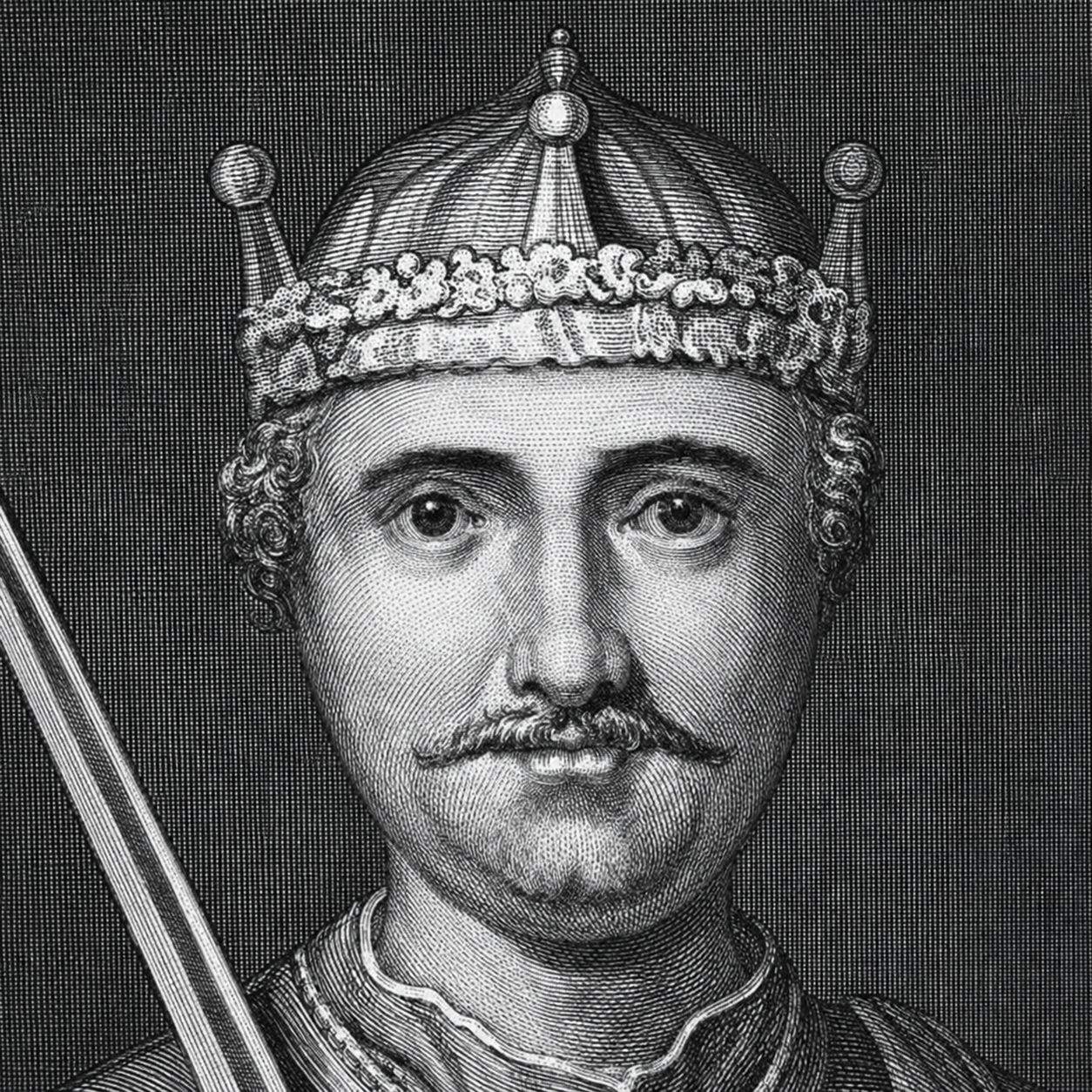
· 20th Great Grandfather
William "the Conqueror
King of England
14 Oct 1024 - 09 Sep 1087William “the Conqueror,” King of England, is identified in this family tree as the 20th great-grandfather of David Andrew Rhudy (Riza). The supplied dates give his life as 14 October 1024 to 9 September 1087. Family-tree notes describe his succession as Duke of Normandy, his invasion of England in 1066, and his rule as king until his death.
William “the Conqueror” is identified in the supplied family tree as King of England and as the 20th great-grandfather of David Andrew Rhudy (Riza). His supplied life dates are 14 October 1024 to 9 September 1087. The accompanying notes, however, give his birth as “circa 1028” at Falaise, Normandy, France.According to the notes, William was the illegitimate son of Robert I, Duke of Normandy. Robert died in 1035 while returning from a pilgrimage to Jerusalem. William then became Duke of Normandy at about eight years of age. His early rule was said to have been marked by violence, corruption, and struggles among feudal barons seeking control of the duchy. The notes state that some of his guards were killed and that his teacher was murdered during this period of anarchy.
The notes further state that King Henry I of France helped William survive these early years and knighted him in 1042, when William was still in his teens. William later gained firm control of Normandy, despite being called “The Bastard” by enemies because of his illegitimate birth. By 1064, the notes say, he had conquered Brittany and Maine.
The supplied account states that Edward the Confessor, King of England, was childless and had promised William succession to the English throne. When Edward died in 1066, Harold Godwin claimed the throne with the support of the Witan, a council of English lords. The notes characterize this as a betrayal of an oath by Harold to support William’s claim.
William assembled a fleet and army on the French coast to invade England, but north winds delayed the crossing for several weeks. Meanwhile, a Norwegian army invaded England from the north. Harold marched north and defeated the Norwegians, then returned south to meet William’s forces. The supplied notes state that William won the Battle of Hastings in 1066 and was thereafter crowned King of England.
William ruled England from 1066 until his death on 9 September 1087. The notes place his death in Rouen, France. They also state that he never spoke English and was illiterate, and they credit him with major influence on the development of the English language. Another broad assessment in the notes suggests that his policies may have contributed to Britain eventually becoming the most powerful nation in Europe; this is presented as an interpretive claim rather than an established conclusion in the supplied material.
The relationship path supplied for this family line is: William “the Conqueror,” King of England; Henry I, King of England; Robert FitzRoy, 1st Earl of Gloucester; Mabel FitzRobert of Gloucester; Nest verch Gruffudd of Dynevor; Rhys ap Hywel of Talgarth; Lowri ferch Rhys; Margred II ferch Dafydd; John Michael Jones; Thomas Jones; Catherine Jones; Cecil Vaughan; Edmund Basset; Elizabeth Basset; David Potts “The Ironmaster”; Ezekiel Potts “Rev. War”; Susannah Potts; John Thomas Spriggs; Zion Spriggs; Martha Emma “Mattie” Spriggs; Thomas Henry Riza; Randall Jasper Riza; and David Andrew Rhudy (Riza).
Historical context
The supplied notes place William’s life within the political struggles of eleventh-century Normandy and England. They describe conflict among Norman barons after he became duke, the role attributed to King Henry I of France in his survival, and the disputed English succession following the death of Edward the Confessor in 1066. William’s successful invasion and subsequent coronation are presented as the beginning of his rule as King of England.
Sources & research
Original Family Tree Maker notes supplied by the user, uncited.
Supplied relationship path for William “the Conqueror” to David Andrew Rhudy (Riza).