Barbara’s family · 12th great-grandfather
Wahunsenacawh Powhatan
Powhatan Confederacy leader
ABT 1547 – BEF APR 1618Wahunsenacawh Powhatan, also referred to in the supplied notes as Wahunsunacock, lived about 1547 to before April 1618. He is identified in this family line as Barbara’s 12th great-grandfather.
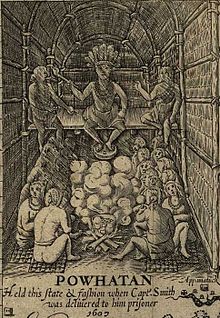
Little is known of Powhatan’s life before English colonists arrived in Virginia in 1607. The supplied notes state that he apparently inherited leadership of about four to six tribes, based near the Fall Line close to present-day Richmond. By the early seventeenth century, he had assembled about 30 tribes into what is described as the Powhatan Confederacy, through diplomacy and/or force. The confederacy was estimated to have included 10,000 to 15,000 people.[2]In December 1607, John Smith was captured by a hunting expedition led by Opchanacanough, identified in the notes as Powhatan’s younger brother. Smith was taken to Werowocomoco, Powhatan’s capital on the York River. In his 1624 account, Smith wrote that Pocahontas, identified as Powhatan’s daughter and as Matoaka by birth, prevented her father from executing him. Because Smith did not include this account in reports of 1608 and 1612, historians have questioned its accuracy. Some have suggested that the episode may instead have been an adoption ceremony in which Smith was ritually accepted as subchief of Capahosic, a town within Powhatan’s alliance.[3] Historian Margaret Williamson Huber is quoted in the supplied notes as saying that placing Smith and his men at Capahosic would have kept them nearby and under Powhatan’s control.[1]
In January 1609, Smith recorded that he directed men to build an English-style house for Powhatan at Werowocomoco in exchange for food for the hungry English colony.[4] Relations remained uneasy. Smith went to Opchanacanough’s village, where he was ambushed and held Powhatan at gunpoint before the warriors. When Smith returned to Werowocomoco, the house was unfinished, the place was abandoned, and the men had gone over to the Powhatan side. Ruins in a village now called Wicomico, Gloucester County, have traditionally been associated with this building and are known as Powhatan’s Chimney.
The supplied notes report that, since 2003, officials and researchers have concluded that the likely site of Werowocomoco is farther west on the York River at Purtan Bay. Archaeological work there found evidence of a large residential settlement dating to about 1200, major earthworks built about 1400, and artifacts including European goods that indicate likely early-seventeenth-century interaction with English colonists. The Werowocomoco Archeological Site was listed on the National Register of Historic Places in 2006.
Powhatan later established a capital at Orapake, about 50 miles west, in a swamp at the head of the Chickahominy River. Sometime between 1611 and 1614, he moved north to Matchut, in present-day King William County, on the north bank of the Pamunkey River near Youghtanund, where Opchanacanough ruled.
After Smith left Virginia in 1609, peace between the colonists and Algonquian peoples deteriorated. Conflict developed into the First Anglo-Powhatan War as English settlement expanded beyond Jamestown into Powhatan territory. The notes state that the colonists destroyed the Kecoughtan and Paspahegh subtribes early in the war. Powhatan sent Nemattanew to act against colonists on the upper James River, while the English held Henricus. After Captain Samuel Argall captured Pocahontas in 1613, Powhatan sought peace. Peace followed her marriage to John Rolfe on April 5, 1614. The supplied notes further state that Reverend Alexander Whitaker converted Pocahontas and baptized her as Rebecca, and that Reverend Richard Buck presided at her wedding to Rolfe.[5]
In Powhatan’s final years, Opchanacanough became the more powerful Native leader in the region. Upon Powhatan’s death in 1618, his next younger brother, Opitchapam, officially became paramount chief, although the notes state that Opchanacanough effectively held the greater power. A later tradition says Powhatan stopped at Big Spring on Sligo Creek, in present-day Takoma Park, Maryland, while returning from a battle near present-day Philadelphia, to recover from wounds in its waters.[8][9] The supplied notes say modern historians have dismissed this story as not credible, though a commemorative sculpture has stood there since 1985.[10]
Through Pocahontas and John Rolfe, Powhatan was the grandfather of Thomas Rolfe. The supplied notes state that Thomas Rolfe returned to Virginia from England in 1635, visited Opchanacanough and an aunt called “Cleopatra,” and later became a commander of James Fort on the Chickahominy after the next war.[6] The notes also report that modern Mattaponi and Patawomeck tribes believe Powhatan’s line survives through Ka-Okee, described there as Pocahontas’s daughter by her first husband, Kocoum.[7]
Historical context
Powhatan’s lifetime included the founding and expansion of the English Jamestown colony. The supplied notes portray his leadership as shaped by diplomacy, conflict, relocation of political centers, and changing relations with English colonists.
Sources & research
Original Family Tree Maker notes, citation [1]: Margaret Williamson Huber’s interpretation that moving Smith and his men to Capahosic would keep them nearby and under Powhatan’s control.
Original Family Tree Maker notes, citation [2]: Estimate that the Powhatan Confederacy included 10,000 to 15,000 people.
Original Family Tree Maker notes, citation [3]: Discussion of Smith’s 1624 account and the possible interpretation of the episode as an adoption ceremony.
Original Family Tree Maker notes, citation [4]: Smith’s January 1609 record concerning an English-style house at Werowocomoco.
Original Family Tree Maker notes, citation [5]: Statements concerning Pocahontas, John Rolfe, conversion, baptism, and marriage.
Original Family Tree Maker notes, citation [6]: Statements concerning Thomas Rolfe’s return to Virginia and later activities.
Original Family Tree Maker notes, citation [7]: Statement concerning modern Mattaponi and Patawomeck beliefs about descent through Ka-Okee.
Original Family Tree Maker notes, citation [8]: The legend placing a battle near present-day Philadelphia.
Original Family Tree Maker notes, citation [9]: The legend of recovery at Big Spring on Sligo Creek.
Original Family Tree Maker notes, citation [10]: The commemorative sculpture at the Big Spring site.