Barbara’s family · 24th great-grandmother
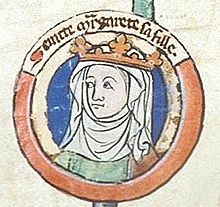
Saint Margaret of Scotland
English princess · Scottish queen
1045 – 16 NOV 1093Saint Margaret of Scotland, also known as Margaret of Wessex and sometimes called “The Pearl of Scotland,” was an English princess who became queen of Scotland through her marriage to Malcolm III by the end of 1070. Remembered in the supplied notes for piety, charitable works, and support for pilgrims, she died on 16 November 1093 and was canonised in 1250.
Saint Margaret of Scotland was born about 1045 in the Kingdom of Hungary. The supplied notes describe her as the daughter of the expatriate English prince Edward the Exile. In 1057, Margaret and her family returned to England.After King Harold II died at the Battle of Hastings in 1066, Margaret’s brother Edgar Ætheling was elected king of England but was never crowned. Margaret and her family later fled north. By the end of 1070, she had married Malcolm III of Scotland, becoming Scottish queen.
The supplied notes describe Margaret as a very pious Christian who performed charitable works. They credit her with establishing a ferry across the Firth of Forth for pilgrims traveling to St Andrews in Fife; according to the notes, this ferry gave South Queensferry and North Queensferry their names. She was the mother of three kings of Scotland, with a possible fourth, Edmund of Scotland, if his rule with his uncle Donald III is counted. She was also the mother of a queen consort of England.
According to the Vita S. Margaritae (Scotorum) Reginae, or Life of St. Margaret, Queen (of the Scots), attributed to Turgot of Durham, Margaret died at Edinburgh Castle in Edinburgh, Scotland, on 16 November 1093, a few days after receiving news of her husband’s death in battle.
Pope Innocent IV canonised Margaret in 1250. Her remains were reinterred in a shrine at Dunfermline Abbey in Fife. The supplied notes state that her relics were dispersed after the Scottish Reformation and were subsequently lost. They further state that Mary, Queen of Scots, once owned Margaret’s head, which was later preserved by Jesuits at the Scots College in Douai, France, and was lost during the French Revolution.
Historical context
Margaret’s life, as presented in the supplied notes, connected the English royal exile in Hungary, the political changes following the Battle of Hastings, and the Scottish monarchy of Malcolm III. Her later canonisation and the tradition of her relics reflect her continuing religious importance in Scotland.
Sources & research
Vita S. Margaritae (Scotorum) Reginae (Life of St. Margaret, Queen [of the Scots]), attributed to Turgot of Durham.
Unidentified reference “[1]” cited in the supplied Family Tree Maker notes.
Original Family Tree Maker notes supplied for this biography.