· 1st Cousin 8x Removed
Richard Stockton
(Signer of Declaration of Independence)
01 Oct 1730 - 28 Feb 1781Richard Stockton (1 October 1730–28 February 1781) was a Princeton, New Jersey, lawyer, jurist, legislator, College of New Jersey trustee, and signer of the Declaration of Independence. During the Revolutionary War he was captured, imprisoned in New York, and released on parole; his health was said to have been permanently damaged by the experience.
Richard Stockton was born on 1 October 1730 at the Stockton family home later known as Morven, in the Stony Brook neighborhood of Princeton, New Jersey. He was the son of John Stockton (1701–1758), a wealthy Princeton landowner who donated land and helped bring the College of New Jersey, then located in Newark, to Princeton. Richard attended Samuel Finley’s academy at Nottingham, later West Nottingham Academy, and graduated from the College of New Jersey in Newark in 1748.He read law with David Ogden of Newark and was admitted to the bar in 1754. He soon developed a distinguished legal practice and received the degree of sergeant at law in 1763, described in the supplied account as the highest legal degree then available. He married Annis Boudinot Stockton, a poet and sister of New Jersey statesman Elias Boudinot. They had six children: Julia, Mary, Susan, Richard, Lucius, and Abigail. Their daughter Julia married Benjamin Rush, another signer of the Declaration of Independence. Stockton’s sister Hannah Stockton (1736–1808) married Elias Boudinot.
Stockton served as a trustee of the College of New Jersey for 26 years. In 1766 and 1767, he suspended his law practice to travel in England, Scotland, and Ireland on college business. He presented King George III with an address from the college trustees acknowledging repeal of the Stamp Act. During this journey he met British political figures said to have been sympathetic to the American colonies, including the Marquess of Rockingham, Edmund Burke, and the Earl of Chatham. In Scotland, he helped secure the acceptance of the college presidency by the Rev. John Witherspoon. The supplied account also relates that Stockton was attacked by a robber in Edinburgh and defended himself with a small sword. He returned to America in August 1767.
In 1768, Stockton took a seat on the New Jersey Provincial Council and was elected to the American Philosophical Society. In 1774, he was appointed to the provincial New Jersey Supreme Court. During the developing conflict between Great Britain and the colonies, he initially favored a moderate course. The supplied notes state that he sent Lord Dartmouth a 1774 plan for American self-government independent of Parliament while retaining the Crown, though this claim is not accompanied by a complete citation.
In 1776, Stockton was elected to the Second Continental Congress and became the first person from New Jersey to sign the Declaration of Independence. That August, he and William Livingston reportedly received the same number of votes on the first ballot for governor of New Jersey. Livingston later won by one vote. Stockton was unanimously elected chief justice of the New Jersey Supreme Court but declined the position in order to remain in Congress.
Congress sent Stockton and fellow signer George Clymer on a two-month journey to Fort Ticonderoga, Saratoga, and Albany, New York, to assist the Continental Army. After he returned to Princeton, Stockton traveled to the home of his friend John Covenhoven, about 30 miles east, in an effort to move his family to safety. On the night of 30 November 1776, Stockton and Covenhoven were captured there by loyalists, taken to Perth Amboy, and turned over to British authorities. The supplied account states that Stockton was put in irons and later confined in New York’s Provost Prison, where he suffered hunger and severe cold.
After nearly five weeks, Stockton was released on parole, with his health reportedly ruined. A parole document required him to give his word of honor not to take part in American affairs during the war, and he resigned from Congress. His home, Morven, was occupied by General Charles Cornwallis during his imprisonment, and its library and furniture were reportedly removed. The Continental Congress directed General George Washington to inquire into Stockton’s treatment, and the supplied notes state that Washington contacted General Howe concerning Stockton and other prisoners. Stockton was paroled on 13 January 1777.
Rumors later circulated in Princeton that Stockton had accepted General Howe’s protection. The supplied material attributes one such rumor to a Tory named Mr. Cochran and cites a letter from the Rev. John Witherspoon questioning its reliability. It further distinguishes Stockton from his first cousin, Major Richard Witham Stockton, who remained loyal to the Crown and emigrated after the war to what became New Brunswick, Canada. The supplied account states that Richard Stockton took the required oath of allegiance to the United States as a prisoner of war and did not submit protection papers under Howe’s proclamation.
When his health allowed, Stockton reopened his law practice and taught law students. About two years after his parole, he developed cancer of the lip that spread to his throat. He died in pain at Morven on 28 February 1781. His remains were taken to Nassau Hall, where citizens, friends, and students of the College of New Jersey attended a public observance. The eulogy was delivered by the Rev. Dr. Samuel Smith, vice president of the college and son-in-law of the Rev. John Witherspoon. Stockton wished to be buried at Stony Brook Meeting House Cemetery in Princeton, reflecting a Quaker connection said to have extended through two generations of his family.
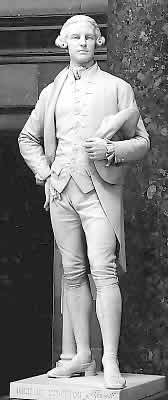
Stockton’s public service was later commemorated in several ways. In 1888, New Jersey donated a marble statue of him to the National Statuary Hall Collection in the United States Capitol. In 1969, the New Jersey Legislature established a state college in his honor; it is now known as Stockton University. A southbound New Jersey Turnpike rest area south of Interstate 195 also bears his name.
Historical context
Stockton lived through the conflict between Great Britain and the American colonies and served in colonial and revolutionary institutions. His career connected the College of New Jersey, provincial government, the Continental Congress, and New Jersey’s early state government. His 1776 signature on the Declaration of Independence placed him among the representatives who formally declared the colonies independent. His capture in late 1776 occurred during the Revolutionary War, when British forces held prisoners in New York and New Jersey.
Sources & research
[1] Election to the American Philosophical Society in 1768; complete source details were not supplied.
[2] Account of Stockton’s and John Covenhoven’s capture on 30 November 1776; complete source details were not supplied.
[3] Account of Stockton’s transfer to Perth Amboy, imprisonment in irons, and treatment as a common criminal; complete source details were not supplied.
[4] Account of Stockton’s imprisonment, harsh treatment, and release on parole; complete source details were not supplied.
[5] William Stryker, statement that Morven was denuded of its library and furniture; complete publication details were not supplied.
[6] Dr. Benjamin Rush, statement concerning his wife’s father, plundering by the British army, imprisonment in New York, and return on parole; complete source details were not supplied.
[7] General Howe’s parole document signed by Stockton; complete archival or publication details were not supplied.
[8] General William Howe and Lord Howe to Lord George Germain, 25 March 1777, enclosing a statement concerning declarations subscribed following the proclamation of 30 November; complete repository details were not supplied.
[9] Account that Stockton took an oath of allegiance to the United States as a prisoner of war and did not submit protection papers; complete source details were not supplied.
[10] Rev. John Witherspoon, letter to his son David concerning the rumor attributed to Mr. Cochran; complete date and repository details were not supplied.
[11] Account distinguishing the conduct of a distant cousin from that of Richard Stockton; complete source details were not supplied.
[12] Account identifying Major Richard Witham Stockton as a first cousin who remained loyal to the Crown and emigrated to what became New Brunswick, Canada; complete source details were not supplied.
[13] Rev. Dr. Samuel Smith, funeral eulogy for Richard Stockton at Nassau Hall; complete publication or manuscript details were not supplied.
Citation needed: Stockton’s 1774 plan of self-government sent to Lord Dartmouth.
Citation needed: Stockton’s reported statement about colonial representation in the House of Commons in 1775.
Citation needed: The statement that it took Stockton nearly two years to regain his health after parole.
Citation needed: The listing of Stockton’s six children.
The New Jersey Gazette, 7 March 1781, notice praising Stockton’s public service; complete issue and page details were not supplied.