Barbara’s family · 10th great-grandfather
JOHN WALKER (Immigrant-signed Portsmouth Compact)
ABT 1603 – AFT 18 MAR 1647John Walker, born about 1603 and living after 18 March 1647/48, is identified in the supplied family material as an immigrant and as a signer of the Portsmouth Compact of 7 March 1638. He is listed as Barbara’s 10th great-grandfather through his daughter Sarah Walker and the Sands, Parker, and Waters lines.
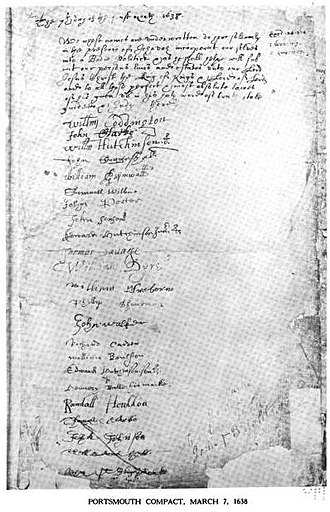
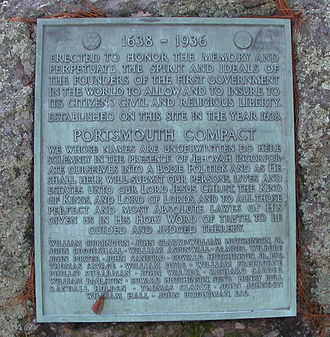
John Walker was born about 1603. The supplied family material identifies him as an immigrant, though it provides no date or place of immigration.On 7 March 1638, Walker was one of the men who signed the Portsmouth Compact, an agreement associated with the settlement of Portsmouth on Aquidneck Island, in what is now Rhode Island. His name appears among the twenty-three signers listed in the supplied notes.
Walker was living after 18 March 1647/48. No wife, residence, occupation, or additional biographical details are provided in the supplied material.
In the supplied descent line, John Walker was the father of Sarah Walker. Sarah was the mother of James Sands; James Sands was the father of John Sands; John Sands was the father of Nancy Sands; Nancy Sands was the mother of Catherine “Kitty” Parker; Catherine was the mother of William V. Waters; and the line continues through Darius Waters, William James Waters, James Benjamin William Waters, James Dempsey Waters, and James Dempsey Waters to the present family connection. He is identified as Barbara’s 10th great-grandfather.
Historical context
The supplied family-tree notes describe the Portsmouth Compact as a document signed on 7 March 1638 that established the settlement of Portsmouth, now in Rhode Island. The notes state that its signers were Christian dissidents seeking religious freedom from the governmental oversight of the Massachusetts Bay Colony and that they moved to Aquidneck Island to establish a new colony. The notes further characterize the colony as Christian in character and non-sectarian in governance, and describe the compact as having been called “the first instrument for governing as a true democracy.” These characterizations are presented in the supplied notes without citations.
The notes reproduce the compact’s opening date as “The 7th Day of the First Month, 1638,” followed by a declaration that the signers incorporated themselves into a “Bodie Politick” and would submit themselves to Jesus Christ and to the laws given in Holy Scripture. The listed signers are William Coddington, John Clarke, William Hutchinson, John Coggeshall, William Aspinwall, Samuel Wilbore, John Porter, John Sanford, Edward Hutchinson Jr., Thomas Savage, William Dyre, William Freeborn, Phillip Shearman, John Walker, Richard Carder, William Baulston, Edward Hutchinson Sr., Henry Bull, Randall Holden, Thomas Clarke, John Johnson, William Hall, and John Brightman.
The supplied notes also mention Anne Hutchinson as among the dissidents connected with the move and state that she had been banished from Massachusetts Bay following the Antinomian Controversy.
Sources & research
No identifiable source citations were supplied.