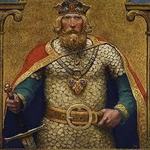
Barbara’s family · 30th great-grandfather
Gorm den Gamle Knudsøn (King of Denmark)
AFT 895 – ABT 958Gorm den Gamle Knudsøn, known as Gorm the Old, was a 10th-century ruler identified in the supplied material as King of Denmark. He was reportedly the son of Harthacnut and the husband of Thyra. His rule is associated with Jelling, the earliest Jelling Stone, and the early political consolidation of Denmark. The supplied material dates his life from after 895 to about 958, while also noting later possible death dates of 963 or 964.
Gorm den Gamle Knudsøn, also called Gorm the Old, was a 10th-century ruler identified as King of Denmark. The supplied material gives his life dates as after 895 to about 958, while also describing him as born before 900. It further notes that his death may instead have occurred in 963 or 964.He was reportedly the son of the semi-legendary Danish king Harthacnut, also called Hardeknud. According to the supplied account, Harthacnut gained power in early 10th-century Denmark after deposing the young king Sigtrygg Gnupasson. When Harthacnut died, Gorm succeeded to power; the account says that he may have taken part of the kingdom by force from Gnupa.
Gorm's seat was at Jelling in Jutland. Some sources cited in the supplied material suggest that his authority may have extended only over Jutland and nearby islands rather than all of Denmark. He is said to have been first mentioned in 936, when he hosted Archbishop Unni of Hamburg and Bremen. His reign is described as a period of political consolidation and monumental commemoration.
Gorm married Thyra, later called Thyra Danebod. Her parentage is described as uncertain in later sources. He is credited with raising one of the great burial mounds at Jelling and with erecting the older of the Jelling Stones in Thyra's honor. The stone's inscription is rendered in the supplied material as: “Gorm king made these mounds after Thyra his wife, Denmark’s adornment.” Saxo Grammaticus is said to credit Thyra with building the Dannevirke fortification in southern Jutland.
The supplied material identifies at least three sons: Toke, Knud Danaást, and Harald Bluetooth. Harald Bluetooth later erected the larger Jelling Stone after Gorm's death, honoring both Gorm and Thyra. That later monument records Harald's unification of Denmark and Norway and the Christianization of the Danes.
Gorm is described in the supplied material as the first known ruler to call himself King of Denmark. The extent of his kingdom, the circumstances of his accession, and his exact death date remain qualified or uncertain in the material provided.
Historical context
Gorm's life belongs to the 10th century, when Denmark's political organization and royal identity were developing. The monuments at Jelling are central to the supplied account of his legacy. The older stone commemorated Thyra, while the larger stone raised by Harald Bluetooth later commemorated both parents and associated Harald's rule with the unification of Denmark and Norway and the Christianization of the Danes.
Sources & research
Wikipedia: Cited repeatedly in the supplied notes for Gorm's dates, parentage, accession, rule at Jelling, meeting with Archbishop Unni, marriage to Thyra, the Jelling monuments, and his sons. No article URL, author, publication date, or access date was supplied.
FamilySearch.org: Cited in the supplied notes for the wording of the older Jelling Stone inscription and for the larger Jelling Stone raised by Harald Bluetooth. No record or page URL was supplied.
historyexplained.org: Cited in the supplied notes for the claim that Gorm was the first known ruler to call himself King of Denmark. No article URL, author, publication date, or access date was supplied.