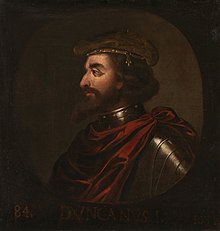
Barbara’s family · 25th great-grandfather
Duncan I of Scotland
15 AUG 1001 – 14 AUG 1040Duncan I of Scotland, identified in this family tree as Barbara’s 25th great-grandfather, was king of Scotland from his accession after the death of King Malcolm II on 25 November 1034 until his death, probably on 14 August 1040. His parentage and marital history have been described differently by later writers; modern accounts cited in the supplied notes identify him as the son of Crínán of Dunkeld and Bethóc, daughter of Malcolm II. He was killed during a campaign in Moray, near Elgin, by men of Moray led by Macbeth.
Duncan I of Scotland was born on 15 August 1001, according to the supplied family-tree record. His ancestry is not certain. Modern accounts cited in the original notes describe him as the son of Crínán, hereditary lay abbot of Dunkeld, and Bethóc, a daughter of King Malcolm II. A much later account by the historian Frederic Van Bossen offered a different descent, identifying Duncan as a son of Abonarhl ap Crinan and Princess Beatrice, described as the eldest daughter of Malcolm II and Gunora. This later account should be treated as a reported historical claim rather than an established parentage.Duncan succeeded his grandfather, Malcolm II, as king after Malcolm’s death on 25 November 1034. The succession is described in the supplied notes as having occurred without apparent opposition, and Duncan may have been Malcolm’s acknowledged successor or Tànaiste. Earlier historians proposed that he had ruled Strathclyde during Malcolm’s lifetime, from 1018 to 1034, but modern historians cited in the notes discount that view, while the Oxford Dictionary of National Biography is said to support it.
The early years of Duncan’s reign are described as apparently uneventful. Macbeth, also called Mac Bethad mac Findláich, is recorded as Duncan’s dux, a term that the notes explain then carried the older Roman sense of a war leader. The notes suggest that Macbeth may have held substantial power during Duncan’s reign, but this is presented as interpretation rather than certainty.
In 1039 Duncan led a large Scots army south to besiege Durham. The expedition ended in disaster, although Duncan survived. In the following year he led an army north into Moray, Macbeth’s domain, apparently on a punitive expedition. Duncan was killed in action at Bothnagowan, now Pitgaveny, near Elgin, by men of Moray led by Macbeth, probably on 14 August 1040. He is thought to have been buried at Elgin and later moved to the island of Iona.
The identity of Duncan’s wife is uncertain. A variant of the Chronicle of the Kings of Alba gives her Gaelic name as Suthen, and John of Fordun suggested that she may have been related to Siward, Earl of Northumbria. Van Bossen, writing in 1688, claimed that Duncan married first Wonfrida or Unfrida, daughter of Gigurt, described as Earl Siward of Northumberland and Huntingtoun, and that they had two sons, Malcolm and Donald. Van Bossen further claimed that, after Wonfrida’s death, Duncan married Astrida, daughter of Sigfrid, described as king of Dublin. These reported marital details conflict with other accounts and remain uncertain.
Duncan had at least two sons: Malcolm III, Máel Coluim mac Donnchada, who was king from 1058 to 1093, and Donald III, Domnall Bán or Donalbane, who later became king. Máel Muire, Earl of Atholl, has also been suggested as a possible third son, but this relationship is uncertain. The supplied relationship path traces descent through Duncan’s son Donald III Bane.
Historical context
Duncan’s reign fell within an era in which succession, regional power, and military leadership shaped Scottish kingship. The supplied notes contrast the historical Duncan, who appears to have been a young man when he became king, with Shakespeare’s later portrayal of “King Duncan” in Macbeth. Macbeth was not merely a literary figure: the notes identify him as Duncan’s dux and as the leader associated with the men of Moray who killed Duncan in 1040.
Sources & research
The original Family Tree Maker notes cite the following sources only by bracketed reference numbers; no full bibliographic details were supplied.
[1] Modern texts cited for the parentage of Duncan as son of Crínán and Bethóc.
[5] [6] Frederic Van Bossen’s late-17th-century account of an alternative parentage for Duncan.
[7] Source cited for Duncan’s succession after Malcolm II and the possibility that he was acknowledged successor or Tànaiste.
[8] Modern historians cited as discounting the earlier claim that Duncan ruled Strathclyde between 1018 and 1034.
[9] Oxford Dictionary of National Biography, cited as supporting the Strathclyde claim.
[10] Variant of the Chronicle of the Kings of Alba, cited for the name Suthen.
[11] John of Fordun, cited for the suggestion that Duncan’s wife may have been related to Siward, Earl of Northumbria.
[12] Frederic Van Bossen, 1688, cited for claims that Duncan married Wonfrida or Unfrida and later Astrida.
[13] Source cited for Duncan’s sons Malcolm III and Donald III and for Máel Muire as a possible third son.
[14] Source cited for Macbeth’s description as Duncan’s dux.
[15] Source cited for Duncan’s 1039 Durham expedition and his 1040 campaign in Moray.
[16] Source cited for Duncan’s death near Elgin, probably on 14 August 1040.
[17] Source cited for the reported burial at Elgin and later relocation to Iona.