Barbara’s family
"Longue-Épée" Guillaume I
2nd ruler of Normandy
28 AUG 893 – 17 DEC 942 · 23rd great-grandfatherGuillaume I "Longue-Épée," commonly known as William Longsword, was the second ruler of Normandy from 927 until his killing on 17 December 942. A son of the Viking Rollo and Poppa of Bayeux, he succeeded his father, expanded Norman influence, and was succeeded by his son Richard.
William succeeded Rollo as ruler of Normandy in 927, although Rollo reportedly lived for about five more years. He is sometimes called Duke of Normandy in later usage, but the title duke was not in common use until the eleventh century. Contemporary usage described him as count of Rouen, while Flodoard called both Rollo and William principes, or chieftains, of the Norse.
Early in William's rule, some Normans rebelled because they believed he had become too Gallicized. Orderic Vitalis identified Riouf of Évreux as their leader. Riouf besieged William at Rouen, but William sallied out and won a decisive battle. During this rebellion, dated in the notes to 933, William sent his pregnant partner Sprota to Fécamp, where their son Richard was born.
In 933, William recognized Raoul as king of Western Francia. Raoul in turn granted him lordship over much of the Breton lands, including Avranches, the Cotentin Peninsula, and the Channel Islands. Alan II, Duke of Brittany, and Count Berenger of Rennes resisted Norman rule. The conflict ended with heavy slaughter and the destruction of Breton castles; Alan fled to England, and Berenger sought reconciliation.
In 935, William married Luitgarde, daughter of Count Herbert II of Vermandois. Her dowry included Longueville, Coudres, and Illiers l'Eveque. William also arranged, with the approval of Hugh the Great, the marriage of his sister Adela, whose Norse name was Gerloc, to William, Count of Poitiers. William supported King Raoul and became a loyal ally of Herbert II, despite Rollo's earlier opposition to both men.
After Raoul died in January 936, William's promise of loyalty helped persuade the sixteen-year-old Louis IV to return from exile in England and become king. The Bretons then returned to recover lands taken by the Normans, and fighting continued in the enlarged Norman territories. In 939, William aided his brother-in-law Herluin II, Count of Montreuil, after an attack by Flanders. Arnulf I, Count of Flanders, retaliated by attacking Normandy and taking Montreuil-sur-Mer, expelling Herluin. William and Herluin retook the castle, but William was excommunicated for attacking and destroying several of Arnulf's estates. When William met Louis IV in 940, he pledged loyalty and was confirmed in lands previously granted to Rollo.
A peace treaty between the Bretons and Normans was arranged at Rouen by Louis IV in 941. It limited Norman expansion into Breton lands. On 17 December 942, William attended a peace conference at Picquigny, on an island in the Somme, to settle differences with Arnulf. He was ambushed and killed by followers of Arnulf.
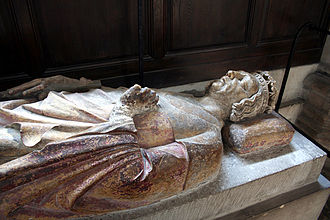
William had no children with Luitgarde. His son Richard, born to Sprota, was about ten years old when he succeeded as ruler of Normandy in December 942. A fourteenth-century funerary monument to William survives in the cathedral of Rouen, France.
Historical context
William ruled during a period in which Norman authority was being established within the political world of Western Francia. His career involved relationships with Kings Raoul and Louis IV, the Breton leadership, the counts of Vermandois and Flanders, and neighboring rulers. Although later writers often use the title Duke of Normandy, the supplied notes emphasize that this was an anachronism for William's lifetime.
Sources & research
Original family-tree-maker notes, citations [1]–[32].
Dudo of Saint-Quentin, cited in the notes regarding Poppa's parentage [9].
Annales Rouennaises (Annals of Rouen), cited regarding Poppa as daughter of Guy, Count of Senlis [10].
Flodoard, cited regarding the styles used for Rollo and William [5].
Orderic Vitalis, cited regarding William's baptism, the date of Rollo's baptism, and Riouf's rebellion [13], [16]–[18].
Longsword's planctus, cited regarding William's baptism [12].
Citations as preserved in the supplied notes: [1], [2], [3], [4], [5], [6], [7], [8], [9], [10], [11], [12], [13], [14], [15], [16], [17], [18], [19]:24, [19]:25-6, [19]:28-9, [20], [21], [22], [23]:lii, [23]:liii, [24], [25], [26], [27], [28], [29], [30], [31], [32].
Editorial note on citation form: the supplied material included numbered citations but did not include the corresponding bibliography.